
Harrison Township Previous Residents by Era
The best first source for previous residents depends on the era and the question. A current Auditor card helps identify the parcel and legal description. Deeds track title parties. Reverse directories and census records supply the household layer for a dated snapshot. Tax duplicates can show an assessment or transfer clue. The Montgomery County Records Center & Archives, Recorder, Dayton Room, and federal-census resources are complementary routes, not one seamless database. This era map gives a realistic starting point for a Harrison Township address.
| Trail source | Verified range | Where to use it | What it can show |
|---|---|---|---|
| Current Auditor property record | Current database, historic web depth not stated | MCRealEstate and Auditor | Listed owner, situs and mailing fields, parcel, legal description, latest sale reference |
| Recorder deed records | 1805-present | Recorder, RISS, and Recorder counter | Recorded transfers, party roles, and legal-description chain |
| Archives deed books and indexes | Deeds 1805-1971; indexes 1805-1928 | Records Center & Archives | Older deed and alphabetical-index route |
| Original-owner tract record | 1801-1830 | Records Center & Archives | Earliest geographic-owner route |
| Auditor tax records | 1803-1983 at Archives; 1984-present at Auditor | Auditor and Archives | Value, improvement, tax, and possible transfer context |
| Directories and census | Volume and release dependent | Dayton Room, NARA, library databases | Period address or household context |
The Archives table gives record-group ranges, not a promise that every current street address appears in every early format. Early records can use a tract, township, section and range, or a lot and subdivision rather than a familiar street number.
Start Harrison Township Past Residents Today
For a current house, use the Montgomery County Auditor property search by address, owner, or parcel. The address route accepts the number and street name, with no direction or suffix. Copy the parcel ID, listed owner, mailing address, situs address, current sale information, and full legal description. The County property guide treats the legal description as the bridge to earlier transfers. It may identify a lot and subdivision or a township, section, and range. The last form is common outside city limits and is a key reason an old street-number search can fail.
A latest-sale buyer can be the current listed owner. That does not establish who lives there, and an owner mailing address may be different from the property situs. This distinction is especially important in previous-resident research. Keep a source note that says listed owner, recorded party, directory listing, or census household rather than flattening every name into the same role.
Trace a Harrison Township Deed Chain Backward
The County's Home and Property Research Guide gives a precise backward route. Begin with the current owner and legal description, then use the latest sale or deed reference. In a purchase, the buyer is usually the grantee and the seller is usually the grantor. Find the older instrument and search the seller as an earlier grantee, or use the tract index when the legal description is the stronger key. Repeat only while the description and document trail support the match. A split, combination, subdivision, or changed description signals a need to change methods.
- Open the Auditor property record and copy the legal description exactly, along with the parcel and current sale reference.
- Search the present owner in the Recorder's index or open the displayed deed reference. Record the instrument date, number, party roles, and legal description.
- Read the earlier deed for the seller or grantor. Search that person as a prior grantee, or follow the same legal description in the tract index.
- Repeat the linked transactions, noting every change in lot, subdivision, or township and section wording.
- When the web route stops, use Recorder terminals, deed books, abstract books, and the Records Center historical indexes instead of forcing an address search.
- Grantor
- The person or entity transferring an interest in recorded land, commonly the seller in a deed.
- Grantee
- The person or entity receiving an interest in recorded land, commonly the buyer in a deed.
- Chain of title
- The sequence of recorded transfers used to trace ownership of the same legal parcel over time.
- Legal description
- The lot, subdivision, or township and section wording that identifies land more reliably than a changing street address.
Harrison Township Deeds Beyond RISS
The Recorder's Information Search System, or RISS, is a modern access route with a guest option after its legal disclaimer. It has name, type, municipality, subdivision, instrument, book and page, date, and other search modes. The Recorder's 2021 notice made RISS the exclusive Recorder database, but the portal does not publish one global online-index start year. The County guide identifies Recorder deed records from 1805 to the present, while the Recorder's public terminals and the Archives provide the older counter and book channels.
Insider tip: RISS calls one form Pre 1980, but its visible year menu covers only 1971 through 1979 for deed and mortgage numbers. It is not a full online doorway to every prior deed. If the address chain reaches earlier years, use the Recorder's fifth-floor terminals or the Archives deed and index collections. That shift is part of the verified process, not a failed search.
The Montgomery County Records Center & Archives is the historical counter route for the earlier chain.
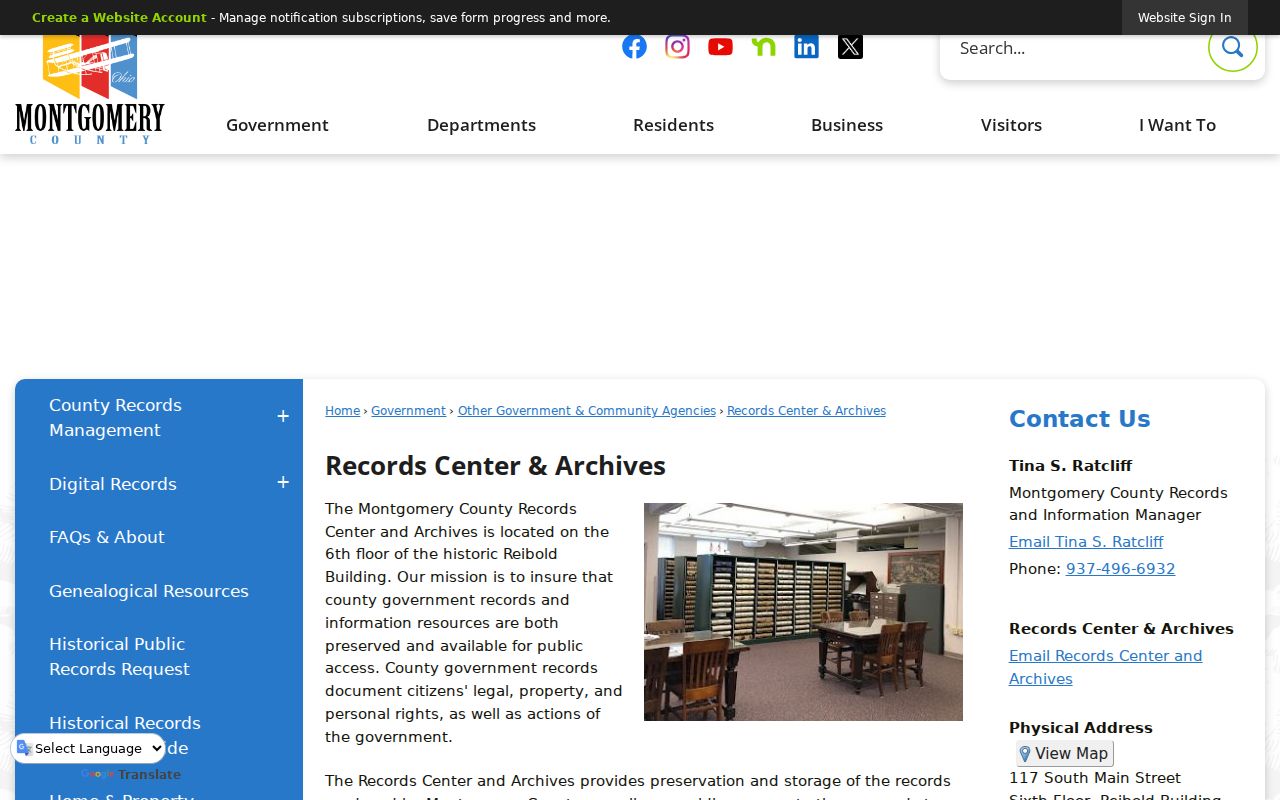
Its archival holdings include deed books, deed indexes, tax duplicates, estate records, maps, and other record groups that supply an offline continuation of a property history.
Harrison Township Tax Duplicates Add Dates
Tax duplicates can add a dated property clue when prior residents are being traced. The County guide identifies annual land value, improvement value, taxes paid or delinquent, and an indication that property changed hands in the tax year. Records Center holdings run from 1803 through 1983, with the Auditor serving the later tax route. Compare names and values across years, but do not treat a value jump as proof that a house was built in that exact year. Economic changes can affect assessed values.
Record the year, parcel or legal description, column heading, and number as printed. Then test a suspected construction or transfer date against a permit, plat, Sanborn map, deed, or newspaper source. That comparison turns a tax clue into a documented house-history step instead of an unsupported date claim.
Note: A tax duplicate can point toward a change in a property, but it does not identify all people who lived there during that year.
Harrison Township Past Households in Print
Deeds trace title. To look for past residents who may not have owned the property, pair a dated directory with the nearest released federal census. The Dayton Room at Dayton Metro Library has more than two centuries of regional historical material, maps, newspapers, local history, census resources, and genealogy help. Its stronger address routes for Harrison Township are the Dayton suburban directories from 1956 forward and Haines City & Suburban Criss-cross volumes from 1945 forward in Local History Reference and from 1954 forward in Genealogy Reference. Ask the desk to confirm an individual volume and the address coverage before relying on it.
Use the household trail in a deliberate order:
- Search a directory year that falls close to the property event or the address period in question.
- Copy the name, address, spelling, publication year, and any occupation or notation printed in that volume.
- Check a reverse or criss-cross directory for the address when one is available, then compare it with a nearby city or suburban volume.
- Pair the date with the closest released federal census, which the National Archives opens under its 72-year release rule.
- Use a deed, tax record, obituary citation, or probate file to distinguish an owner, a directory listing, and a household member.
The collection details and catalog routes are grouped with the Harrison Township city directories. A directory is a period snapshot, not a full census or a permanent residence record.
Map Harrison Township Address History
Maps help test whether an old address belongs to the same place before a previous-residents trail is joined to a deed chain. Dayton Room resources include Sanborn Fire Insurance Maps, and the Library of Congress digitized Dayton volumes carry local labels that matter here. The 1932 volume identifies Drexel Park, Fort McKinley, and part of Harrison Township. The 1955 and 1956 volumes name Fort McKinley, parts of Harrison Township, Shiloh, Northridge, and nearby townships or communities. Inspect each volume's index and key before drawing a conclusion about one parcel.
Harrison Township was founded in 1841, while Montgomery County's original-owner tract records begin in 1801. That makes the county-centered record trail essential for early land. Fort McKinley, Shiloh, Northridge, and Drexel Park can also appear as historic place labels in maps and directories. Preserve old postal labels, directions, lot names, and township or range wording as active search keys.
Previous Residents at a Life Endpoint
When a known former owner or household member has died, an obituary citation or probate record can close part of the trail. The Dayton Library's HOBITS obituary and genealogy database indexes citations rather than full obituary text. Its documented coverage includes 1850-1880, 1897-1898, 1900, 1903-1918, 1920-1939, 1951-1957, 1965, and 1985 forward, with other years added. Requests for copies require a complete citation and are limited to three at a time through the Dayton Room.
The Montgomery County Probate Court maintains estates, wills, guardianships, marriage licenses, name changes, and adoptions. Historical Archives holdings include wills and estates in listed record-group ranges. An estate can show a fiduciary, heirs, inventory, sale, or transfer context in a file, but protected adoption and mental-health material is not readily available. Start this route from a confirmed identity, death notice, or deed-owner relationship rather than a name match alone.
Harrison Township Archives Beyond the Web
The Records Center & Archives is more than a backup screen. It holds deed records, deed indexes, tax duplicates, wills and estates, original-owner tract records, county engineer maps, and Common Pleas material. The Dayton Room has maps, city directories, county histories, and wills. Montgomery County also identifies Wright State University Special Collections & Archives at Dunbar Library for local-government and manuscript material, family histories, and the Miami Valley Genealogical Society Library. These distinct repositories give a past-residents search an offline route when an online index ends.
The Wright State Special Collections page represents the additional regional research channel identified by the County.
Bring the address forms, legal description, dates, and names already found so an archivist or librarian can direct the request to the most likely collection.
Past Harrison Township Household Limits
Previous residents research can establish a dated owner, a recorded party, or a person listed at an address in a particular source. It cannot safely fill gaps with assumptions. A directory can omit someone, a census has its own enumeration date, a mailing address can differ from the property, and a tax record is not an occupancy record. Protected voter data, restricted court records, and confidential programs also remain outside a public address trail.
Use a Harrison Township house history for family history, estate or heir research, neighborhood history, or personal curiosity. Verify material facts with the office that holds the record and do not use partial information to track, harass, or harm a living person.
Lawful use. A past-residents trail is best used to document a property and its history. Respect confidential records and the safety of living people at every step.