
Harrison Township City Directory Shelves
Harrison Township is unincorporated, so the practical city directory collection is regional. The Dayton Room at Dayton Metro Library is the central public route for Dayton, Montgomery County, and Miami Valley material. Its collection description calls for checking the current catalog before a trip, especially for a particular serial year or a reverse section. For township history, suburban and Haines volumes are often the better starting point than a Dayton city-limits volume. The table keeps the documented runs distinct from a claim of complete township coverage.
| Directory collection | Documented years | Where it is kept | How it is used |
|---|---|---|---|
| Dayton city directories and street guide | 1850-present, almost every year; street guide 1914-present | Dayton Room local-history reference | In-library city and street research; city-limits coverage needs care. |
| Dayton suburban directories | 1956-present | Dayton Room, later North/South series | Address searching across years, a stronger Township route. |
| Haines City & Suburban Criss-cross | 1945-present local history; 1954-present genealogy reference | Dayton Room reference collections | In-library address, name, and phone access. |
| Telephone books | 1919-present, most years in the stated collection | Dayton Room local-history reference | Name and telephone research, not a street index. |
| Polk current city serial | 1995-present in the collection description | Dayton Room catalog | Confirm the current status and year with staff. |
The historical description reports Dayton volumes from 1850 to the present and a street guide from 1914, but a particular issue still needs catalog confirmation. A Wright family finding aid documents a narrower 1899/1900-1908/1909 group. Polk and Equifax headings appear in the public catalog, yet their browse results did not expose a dependable full date run. That is why the title page, publisher, year, and index type should be written down for every consulted volume.
- 1850: the stated Dayton city-directory coverage begins, with almost every year represented.
- 1914: the documented Dayton street guide begins its alphabetical-street and ascending-number arrangement.
- 1945 and 1954: the two stated Haines reference runs begin for local history and genealogy.
- 1956: the documented suburban-directory series begins, a stronger route for many Township addresses.
Note: A directory is a dated regional snapshot, not proof that every person at an address was listed.
Harrison Township City Directories Beyond Dayton
Dayton city directories serve Dayton city limits. A person who worked in Dayton may appear even when the residence lay outside those limits, and a township resident can be missing from a city volume. The 1956-present suburban series addresses that mismatch. More recent issues divide into North and South series, so the desk or catalog is the right place to confirm which volume fits a North Dixie Drive, Northridge, Shiloh, Fort McKinley, or other Harrison Township address.
Haines City & Suburban Criss-cross directories are especially useful when the address is known but the name is not. The cited local-history reference run begins in 1945, while the genealogy-reference run begins in 1954. These are in-library resources. Their address, name, and phone organization creates a second path into a household trail, but each volume reflects the format and date of its own publication.
A city directory result should be read as a lead. Compare its street, postal label, and date to the county parcel record or historical tax and deed sources before treating it as a firm township connection.
Harrison Township Dayton Room Research
The Dayton Room is on the second floor of the Main Library at 215 E. Third Street in Dayton. The Library publishes Monday through Thursday access from noon to 4 p.m., with other availability by appointment, and gives 937-463-2665 and history@DaytonMetroLibrary.org for the room. Its open-stack genealogy collection is available during library hours. Researchers can also arrange a one-on-one genealogy-librarian appointment when a name, map, or local directory needs closer interpretation.
The Dayton Room history page describes more than 200 years of regional books, photographs, maps, manuscripts, newspapers, and other local material, along with computers, microfilm scanners, flatbed and cradle scanners, and local-history expertise.
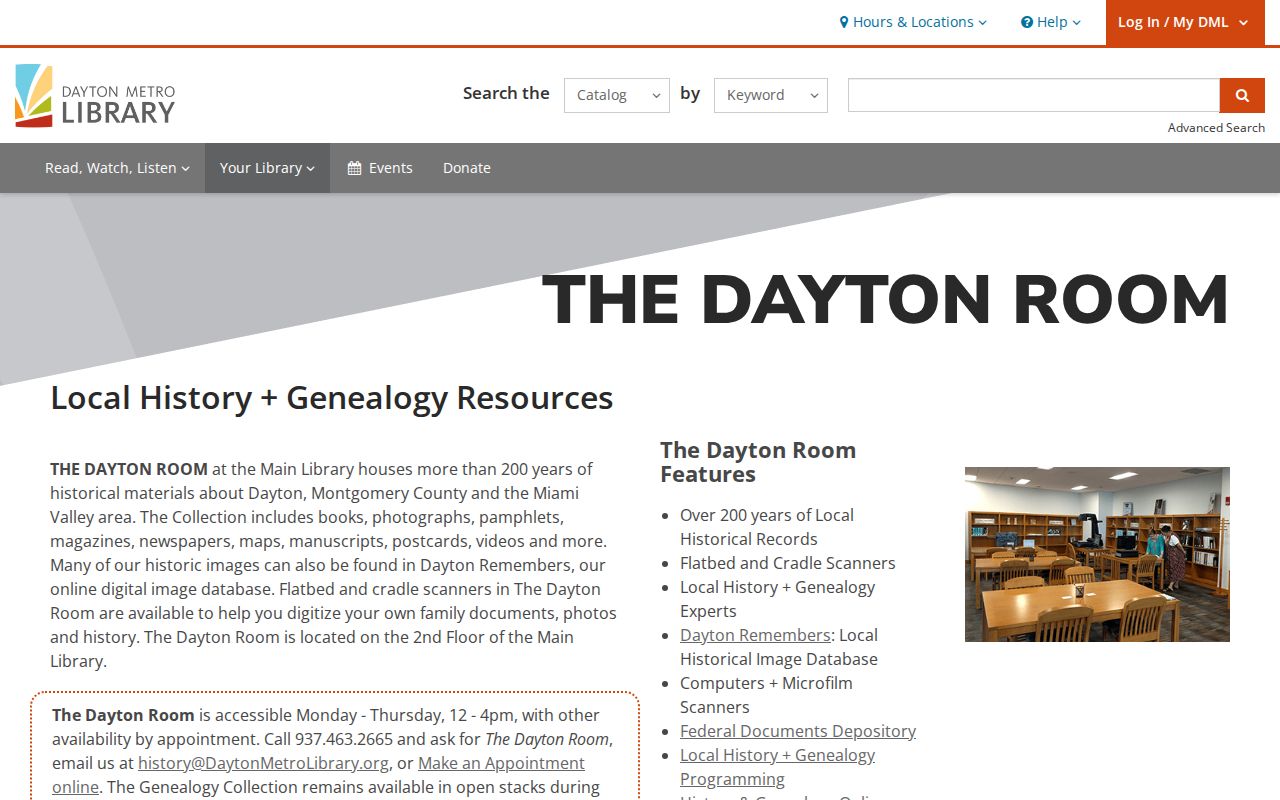
The room provides the on-site setting for checking the actual volume, its title page, and the reference tools that explain it.
When an online portal stops at a modern record, the Dayton Room offers a useful historical fallback: a directory volume, newspapers, census tools, maps, an obituary citation, and staff contact in one local-history channel.
Harrison Township Directory Companions
Directory entries gain value when paired with materials that answer a separate question. Dayton Metro Library lists in-library Ancestry Library Edition, HeritageQuest, Fold3, Dayton Daily News databases, an obituary and genealogy resource, Ohio Death Certificate Index, Ohio Memory, Sanborn Fire Insurance Maps, and Dayton Remembers. Each has its own access terms. The goal is not to force a match, but to compare a spelling, address, family relationship, or date against a record kept for a different purpose.
The Library resource directory is the starting point for those genealogy and history databases.
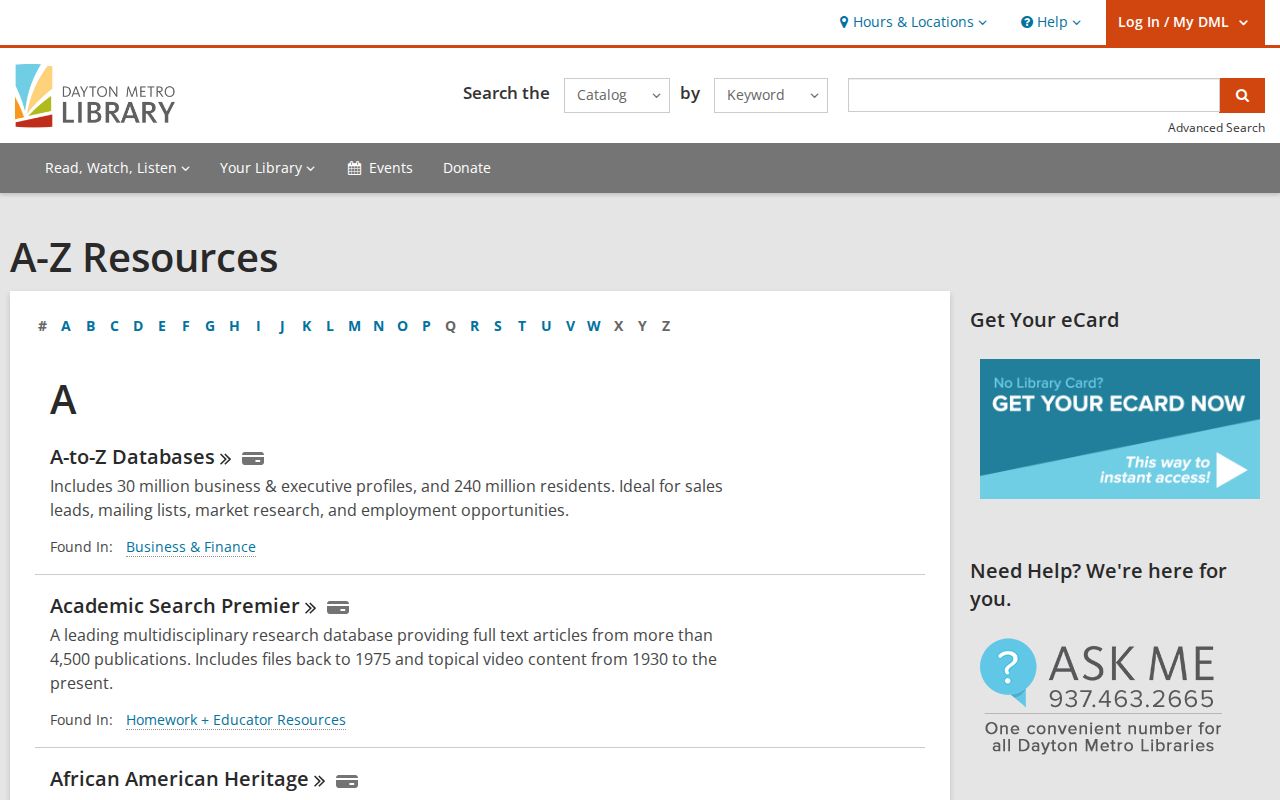
Use the resource listing to identify the relevant database before asking the Dayton Room for access, a citation, or a visit appointment.
The County Records Center & Archives supplies another layer. It can connect an address from a directory to deeds, deed indexes, tax duplicates, wills, and estates. Its research area permits inspection and copies from records that are not open-browsing stacks.
Reading Harrison Township City Directory Entries
Record the volume before interpreting the line. A Dayton Metro Library archivist's reproduced 1914 example shows a name, an office location, an organizational role, a residence description, and abbreviations. The resource says person entries generally carry name, occupation, workplace, residence, and sometimes spouse information. Business entries can show location, industry, owner, and officers. The volume itself is the authority for its marks, so photograph or transcribe the title page and abbreviation key with the entry.
| Name and spelling | Copy the heading exactly, including initials and alternate spellings. |
|---|---|
| Occupation or role | May distinguish same-name people and provide a cross-check for another record. |
| Place and residence | Can separate an office or organization address from the residence description. |
| Spouse or widow notation | When printed, it can help distinguish a household or suggest a later record to check. |
| Street-order listing | The 1914 guide arranges streets alphabetically, then numbers in sequence, followed by people and businesses. |
- Criss-cross directory
- An address-first directory that can lead from a street number to a listed name and phone entry.
- Householder index
- An alphabetical access point for a person or household when the volume provides one.
- Abbreviation key
- The volume's own explanation of its shortened terms and marks; check it before expanding a notation.
Note: A residence line is historical evidence for that volume's date, not a complete modern household roster.
Harrison Township Haines Directory Access
The public catalog gives a practical way to verify that a shelf exists before visiting. The Williams' Dayton City Directory catalog record identifies a current library record and an in-library-use notice. Separate catalog records document the Dayton North Suburban series and the Haines City & Suburban Criss-cross collection. A catalog record confirms a route, not that every issue will be immediately available.
The Williams catalog record is a useful check before beginning a city directory request.
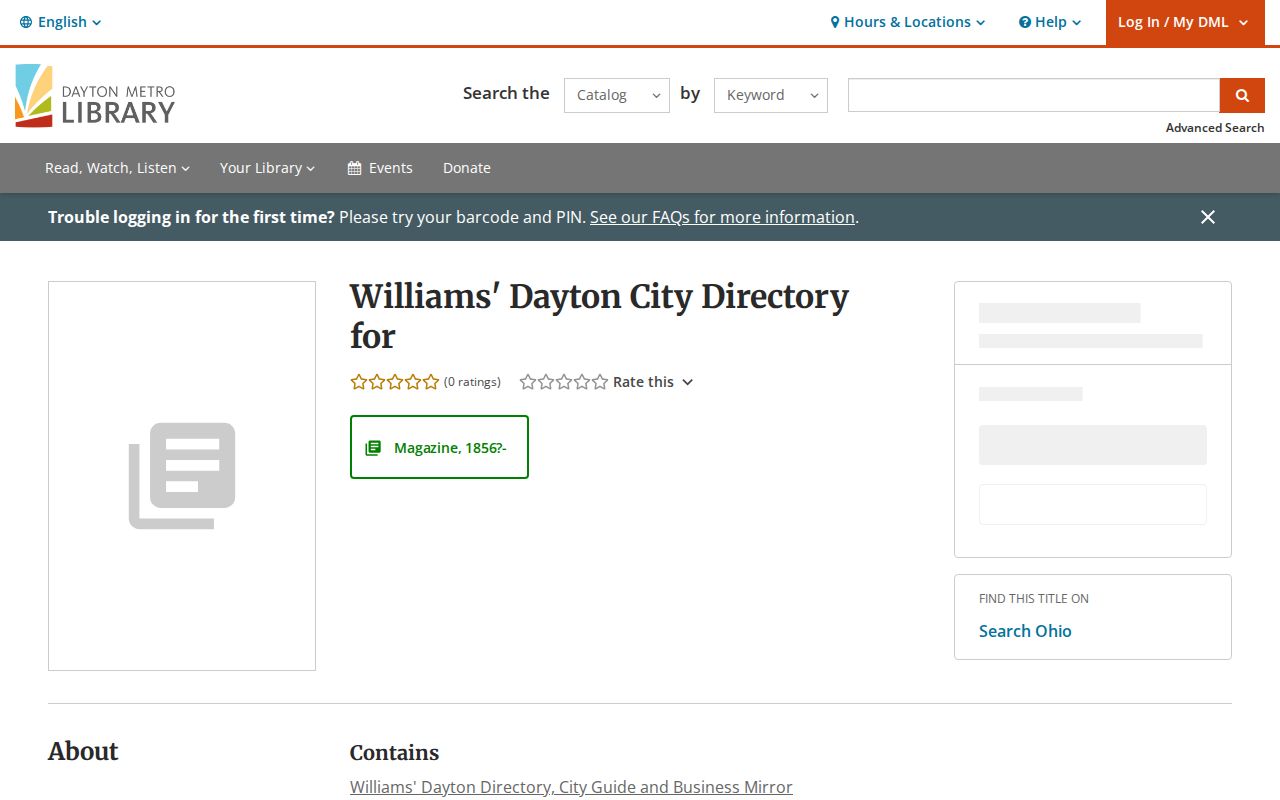
The catalog image supports a desk-and-shelf workflow, where the exact year and access status are confirmed before the directory is handled.
Ask for the title, publication year, format, location, and whether a street or reverse index exists. That short request avoids assuming that an address-friendly index accompanies every serial issue.
Harrison Township Sanborn Map Context
Maps can clarify a street name or building pattern beside a city directory finding. Dayton Metro Library provides Sanborn resources for Ohio coverage from 1882 to 1962, with access rules noted by the Library. The Library of Congress has digitized Dayton volumes whose titles include local places: the 1932 volume names Drexel Park, Fort McKinley, and part of Harrison Township; the 1955 and 1956 volumes name Fort McKinley and parts of Harrison Township with nearby communities.
The Dayton History Archive Center is another regional historical lead. Dayton History describes an archive holding millions of Dayton-region artifacts and notes the earlier Montgomery County Historical Society.
Archive collections and map context can test a locality name or street pattern, but they do not substitute for an entry in a dated directory.
This is a local records story worth keeping in view: Fort McKinley, Shiloh, Northridge, and Drexel Park can appear in map and directory geography even when the postal or municipal label differs from Harrison Township.
Harrison Township Obituary Citations
A directory disappearance can signal a move, a changed spelling, a missed publication, or a death. The public Dayton Obituary and Genealogy Database, HOBITS, is a citation index rather than a full-text obituary archive. Its fields include keyword, first and last name, publication, date controls, publication information, and sorting. The documented coverage includes 1850-1880, 1897-1898, 1900, 1903-1918, 1920-1939, 1951-1957, 1965, and 1985-present, with other years being added.
HOBITS supplies the citation details needed for a copy request or a follow-up at the Dayton Room.
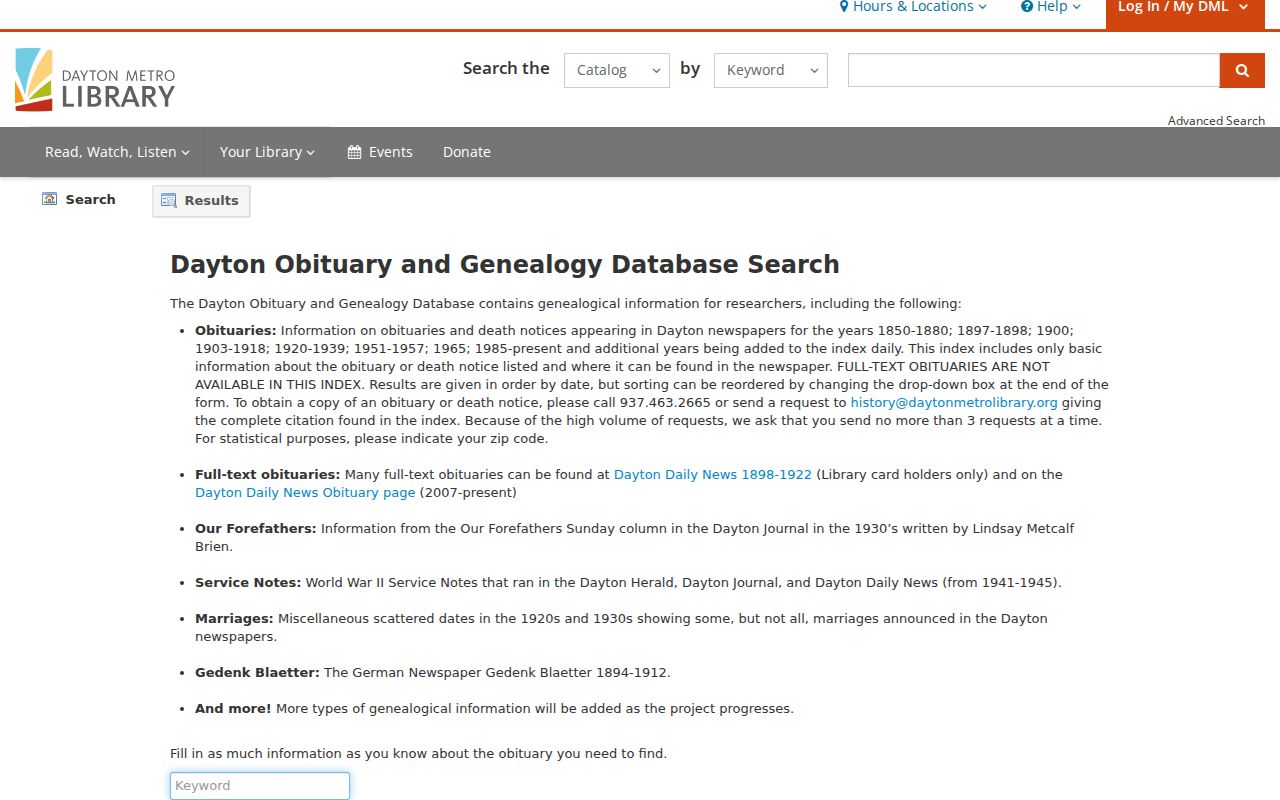
The image shows why a complete citation, rather than a guessed date, makes a directory follow-up more useful.
For a requested copy, the Library asks for a complete citation and limits requests to three at a time through the Dayton Room contact channel. An obituary can close a research trail, but it remains a source to compare with probate or official certificate records when accuracy matters.
Tracing Harrison Township City Directories
Start with one exact directory year and preserve what it actually says. A careful sequence shows movement without converting a single listing into a conclusion. The National Archives releases federal census records after its 72-year rule, so census material can fill some gaps between directory years. County property, tax, probate, and obituary sources then test whether the listed person was an owner, a resident, a relative, or simply a recorded party.
- Find the first useful name or address in a dated volume and copy the spelling, address, abbreviations, and year.
- Check adjacent available volumes for an address move, changed notation, or disappearance.
- Use a Haines or other reverse directory when the relevant year has an address route.
- Compare the result with the closest released federal census and keep the differing dates visible.
- Use an obituary citation, probate record, tax duplicate, or deed source to test the final transition.
The Harrison Township street records route is the appropriate next stop when the question shifts to current parcel and address evidence. Historical directory lines should remain on their own dated trail.
Note: Preserve the year and source for each entry so later researchers can repeat the same comparison.
Limits of a Harrison Township City Directory
Myth: A Dayton listing automatically proves a person lived inside Harrison Township. It does not. Dayton city directories are bounded by the city collection's own purpose, while a workplace or organization line can differ from the residence line. A Township resident may appear in a Dayton volume, and a Township household may be better represented in the suburban or criss-cross shelves.
The wider Montgomery County archival path helps resolve a doubtful entry. The Records Center & Archives has county records extending to 1803, including stated deed, tax, estate, and court groups. Wright State Special Collections and Ohio History Connection are further documented research channels when the Library cannot supply the needed record. Confirm the custodian, record group, and access terms before relying on an old lead.